 |
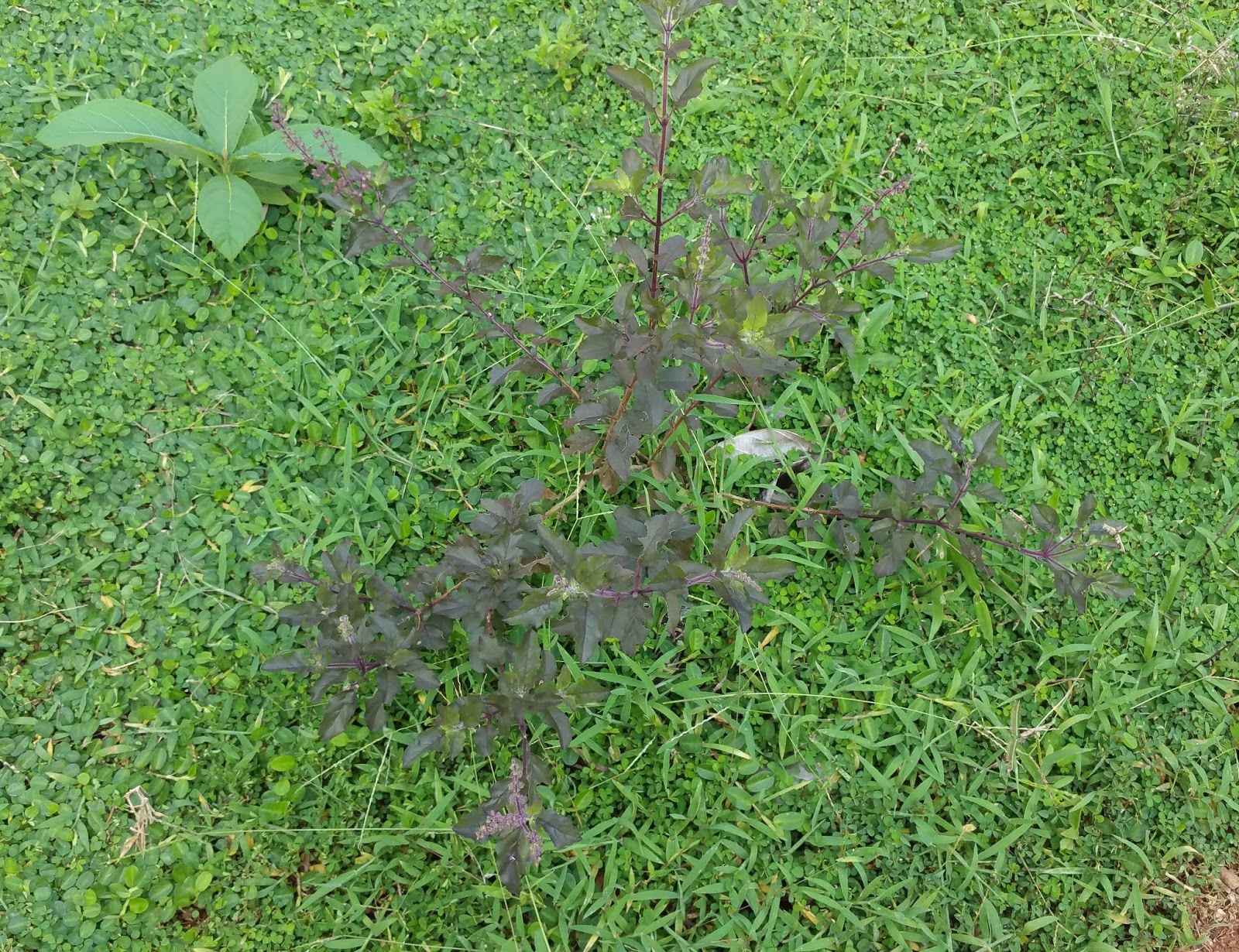
| Krishna Thulasi/Ocimum sanctum & Thekku/Tectona grandis saplings in the undergrowth |
Showing posts with label India. Show all posts
Showing posts with label India. Show all posts
Friday, 30 November 2018
November Rains - One
November rains in Thiruvananthapuram are pleasantly cool and not
chilling as they are in Northern India. The rains this time brought forth a
Krishna Thulasi/Ocimum sanctum and a Thekku/Tectona grandis along with the usual undergrowth.

Thursday, 14 April 2016
Sacred Groves - a rich abode of biodiversity in Kerala; now on the verge of extinction.
- stated a report over a year ago in March 2015, prepared by a Committee chaired by State Minister for Forest, Sports and Cinema Thiruvanchur Radhakrishnan, which was tabled in the ongoing Assembly session then.
The report went on to state that , 'the sprawling patches of sacred groves; the rich abode of biodiversity seen in and around villages across Kerala, are on the verge of extinction due to large-scale construction following demographic changes.'
'Known as 'sarpakavu' or 'kavu' in local parlance, sacred groves are traditional places of worship with some of them having idols of snakes and goddesses.'
'The increase in number of construction of new buildings in the place of ancestral homes, which used to house sacred groves in their premises, have virtually led to the destruction of this biodiversity system.'
'The report also said indiscriminate grazing in the last few decades, uncontrolled felling of trees for firewood and changes in the pattern of worship (from nature worship to temple) have also contributed to the dwindling of groves.'
'Groves are home to a large number of rare flora and fauna, including those facing extinction threat. As many as 475 species of birds, 100 species of mammals, 156 species of reptiles, 91 species of amphibians, 196 species of fishes and 150 varieties of butterflies can be seen in the groves in the state.'
'Though there were about 10,000 groves in the princely state of Travancore before the formation of Kerala, only 1,200 of them remain now.'
'Coastal district Alappuzha has the highest number of groves, while high-range districts of Idukki and Wayanad have the lowest number.'
'Iringorkavu", spread over 2.5 acres in Perumbavur in Ernakulam district, is the largest grove in the state.' it said.'
Some Observations:
1. The report failed to mention a law - 'The Kerala Joint Hindu Family System (Abolition) Act, 1975' which wrought havoc in joint Hindu families who were conserving most of the sacred groves and the flora and fauna in them, in Kerala. Partition deeds for share of the lands to be given to each family member- increased- much more than the species existing in these sacred groves.
2. Sacred Groves are precious assets. Only those who have worshipped in these glorious places can preserve them through traditional practices distilled with their rich traditional knowledge of nature.
3. Traditional knowledge which was passed from generation to generation mostly through women of the families was cruelly disrupted.
4. Close relationships within most families were broken through 'The Kerala Joint Hindu Family System (Abolition) Act, 1975' law which only encouraged conflict between members to battle each other in courts of law.
5. All sorts of predators... still prowl around vulnerable family members to draw one into ...prolonged court cases
6.The snakes in the Hindu sacred groves were more trustworthy, dependable... than these *vile predators*.
7. The pattern of worship from nature to temples (that are now *controlled* by the Government (via the various Devaswom boards) bringing in much money (?) was a corollary.
8.The Marumakkathayam Law which gave inalienable rights to property and right to matrilocality to girls protecting them in the eventuality of a serious mental illness disability was abolished too as it is mentioned in 'The Kerala Joint Hindu Family System (Abolition) Act, 1975'
9. So many women with serious mental illness disability who could heal in the environment of the quiet peaceful rich sacred groves in Kerala were adversely impacted which is strangely overlooked by ...academics, historians.
Tuesday, 9 June 2015
On World Oceans Day...
...when the waves reach out...
When the waves come lapping closer to places where people have been living for years...
Not easy to put a Physalia physalis with its poisonous stings back into sea without getting hurt by its toxic poison. Hands have to be covered with thick gunny bags.
Physalia physalis moves only with the wind and sea currents
 |
| ...in Kerala, India |
When the waves come lapping closer to places where people have been living for years...
 |
| ...the tides are moving in closer... |
 |
| A Physalia physalis washed ashore |
Physalia physalis moves only with the wind and sea currents
Sunday, 7 June 2015
Hortus Malabaricus:Did Itty Achutan Vaidyar, scholar and co-writer return to his family?
The Hortus Malabaricus is a treasure trove for plant lovers. It was reportedly compiled in 1600s by a team of botanical experts put together by Hendrik van Rheede, governor of the Dutch Malabar. Scholar and physician Itty Achuthan Vaidyar from Dutch Malabar is mentioned as a co-author.

Fifty-two-year-old Umayamma from a small village near Cherthala had never heard the name ‘Hortus Malabaricus’ till a scientist told her about it 20 years ago. But she remembers stories she had heard as a toddler about how her ancestor, a local medicine man, went to the Netherlands over 300 years ago to work on a catalogue of flora of the Malabar.
The doctor from Kadakkarappally here, Itty Achuthan Vaidyar, was a key force behind the completion of ‘Hortus Malabaricus,’ a 17 century treatise on the characteristics of over 700 plants found in the Malabar. The ‘Vaidyar’ (doctor) was one of the leaders of a team of botanical experts put together by Hendrik van Rheede, governor of the Dutch Malabar in the 1670s.
When van Rheede, also a botany enthusiast, set about recruiting experts who could help catalogue the flora of the region, Itty Achuthan was one of the top names on the list. “He learnt about medicinal plants from his ancestors and achieved great prominence at a very young age,” says Umayamma. After his work identifying plants of the region, Achuthan left with the Dutch to help complete the 12-volume ‘Hortus Malabaricus.’ The book later became world-famous as one of the earliest authoritative works of botany.
“But Itty Achuthan Vaidyar never came back home,” says Umayamma. “Some people say his ship sank when it was returning. But I don’t know these things.”
Achuthan left behind his mother and sister, who later moved out of Cherthala. Little that belonged to the Vaidyar remains at Kadakkarappally today.
A small wooden structure called the ‘kuriala,’ said to have been in existence since the time of the Vaidyar, now stands here as a memorial to the doctor. The figures inside the ‘kuriala’ resemble a Shiva idol and Umayamma and family light a lamp here every evening. “Many people from the area light a lamp here dedicating it to ‘appooppan’ (grandfather) whenever there is an auspicious occasion in the family,” says Umayamma.
Vaidyar’s garden of valuable medicinal plants has been reduced to a small grove (‘kavu’) full of trees and plants whose names no one knows.
The place is a temple of sorts for researchers studying ‘Hortus Malabaricus’ or the history of the Dutch in the Malabar. “Many people, even those from the Netherlands, come here with their books or movie cameras to see the grove and the ‘kuriala,’” according to Umayamma.
While visitors come and go, Umayamma and her two children struggle to protect Vaidyar’s land. They have had no help from the authorities in protecting the rare plants here or the memorial to the Vaidyar. “The government had expressed their willingness to take over the land and the memorial. But my uncle insisted that a road be built here first so that the people have at least the basic facilities. We have heard only empty promises from everyone after that,” says Umayamma.
Reference: The Hindu
Saturday, 30 May 2015
Tonglu and Dhotrey Declared *National Biodiversity Heritage Sites* in 2015...
..home to the most striking lichens, the brilliant blossoms of rhododendrons, magnolias, the red panda once not so elusive, the rich repository of plant life, the fragrant air.....the wondrous Eastern Himalayas in India.

1. The National Biodiversity Authority, an Autonomous and Statutory Body of the Ministry of Environment and Forests, Government of India, in its website has recognized the importance of Tonglu covering an area of 230 hectares and Dhotrey covering an area of 180 hectares, both located in the Darjeeling District in West Bengal as *Medicinal Plant Conservation Areas*.
2. On 21 April 2015, the Darjeeling Times had reported -
Tonglu and Dhotrey Declared - National Biodiversity Heritage Sites
'Taking into consideration the immense bio-diversity and natural wealth of the region, the National Biodiversity Authority (NBA) has declared Tonglu and Dhotrey as National Biodiversity Heritage Sites.
The declaration of this region as National Biodiversity Heritage Site will play an important role in conserving the unique and rare flora, fauna and insects that are currently poached and smuggled into China and other countries via Nepal.
Both these forest regions fall under Singhalila National Park, with Tonglu covering an area of 230 hectors, and Dhotrey covers 150 hectors.
Home to the elusive Red Panda and some of the most beautiful varieties of Rhododendrons, Singhalila National Park was recently declared one of the 7 Natural Wonders of the World - by Yahoo.'
References:
1.National Biodiversity Authority
2.Photograph from blog by Amlan
3.DarjeelingTimes.com - Darjeeling News
Wednesday, 20 May 2015
Days of heavy rainfall before the scheduled South West Monsoon
The South West monsoon which hits Kerala is scheduled to begin in 1st June or end of May. A map of this year’s monsoon by the Indian Meteorological Department is given below.

This year the season rainfall from 1 March to 20 May was much higher than the normal rainfall in all the districts of Kerala. Thiruvananthapuram district recorded 598.1mm of rainfall . The normal rainfall during this period is 277 mm. The percentage departure is 116% -an excess
The excess rainfall in all the districts of Kerala, this year has brought flooding of rainwater into homes. Many roads and streets are still waist-deep with water. There is coastal erosion causing havoc to human life, much before the scheduled monsoon.
The laterite soil sprung some wonders after the first heavy downpour.
 | |||
| Fire Ball Lily / Foot Ball Lily (Haemanthus multiflorus) |
There was a surprise from an old coconut tree. An Ipomea growing from within its narrow hollow gave forth blossoms. The lichens still linger on the old coconut trees.
 |
| An Ipomea growing from within an old coconut tree, blossoms |
1. Indian Meteorological Department (Ministry Earth Sciences, Government of India)
Saturday, 8 November 2014
Shrinking spaces for elephants in India, shorter migratory routes to travel
...bringing challenges to farmers.
A newspaper report:
TN’s jumbo-hit farmers to use 'stuffed tigers' to save crop'
Senthil Kumaran, TNN | Nov 7, 2014, 06.52AM IST
KRISHNAGIRI: Frustrated by marauding herds of elephants plundering their crops and worried for their safety, farmers on the border of the Sanamavu reserve forest have struck upon a singular solution to their problem. They've decided to use an old foe of the Indian elephant, the tiger — or replicas of them, anyway — to frighten the jumbos away.
Around 50 farmers in the area placed in their fields, at vantage positions where elephants can't miss them, large stuffed tiger dolls that they purchased in Bangalore. They've also set up speakers on which they will play recorded growls and roars of the big cat. Tigers usually do not mess with elephants and it's unlikely that canny wild elephants will be taken in by the trick, given that some of the dolls have been placed in ridiculously impossible positions -including one reclining on the stump of a coconut tree, two feet of its rear floating in midair -but the farmers have run out of options.
"Jumbos last year destroyed ragi, paddy and vegetable crops in many fields near Soolagiri, Anchetty , Denkanikottai, Udedurgam and Uthanapalli, causing huge losses to farmers," said M R Sivasami, president of farmers' association Tamilaga Vivasayigal Sangam. More than 100 elephants from Bannerghatta Reserve Forest in Karnataka make the journey every year to Sanamavu Reserve Forest, around 10km west of Hosur town.
Foresters say as many as 88 elephants have entered the forest this year, including a large herd that came on the night of October 27. Foresters in February had to drive a herd of 45 wild jumbos from Sanamavu Reserve Forest back to Denkanikottai Reserve Forest, 8km away. The rampaging animals caused so much damage that the government gave each farmer a compensation of Rs10 lakh. More than 300 people from villages in the area blocked the highway between Hosur and Royakottai nonetheless, demanding that the authorities find a permanent solution to the elephant problem.
Some farmers gave up on foresters and decided to find a fix themselves. "We usually burst fireworks and light fireballs when jumbos enter our fields," K Munirajappa, a farmer from Beerjeppalli village, told TOI. "A spark flashed in my mind when I overheard a forester tell a farmer that tigers would scare away elephants." He said he went to Bengaluru the next day and bought four dolls for Rs 3,000.
"When they saw the tiger dolls I bought, many other farmers went and got themselves the same kind of dolls." The farmers have set up 'machaans' from where they plan to monitor elephant herds that stray into their fields so they can play the tiger growls when they are within earshot.
"If it works, I'll purchase more dolls to save my crops," PS Dhimmarayappa, another farmer, said.
link given below -
http://timesofindia.indiatimes.com/city/chennai/On-the-prowl-Stuffed-tigers-Tamil-Nadus-jumbo-hit-farmers-find-novel-fix/articleshow/45064694.cms
Tuesday, 24 June 2014
Why medicinal plants may fade out
'Why medicinal plants may fade out'
CHENNAI: Going by the threat of extinction of many medicinal plants in the country are facing, traditional herbal formulations may soon become history. Kalakkad Mundanthurai Tiger Reserve in Tirunelveli district is home to 58 out of 122 endemic and threatened medicinal plant species found in the Western Ghats and other parts of peninsular India, says a book, 'Biodiversity Governance For Managing Endemic And Threatened Medicinal Plants In India - A Geoinformatic Approach'. Brought out by the National Biodiversity Authority, it aims to lay a roadmap for conservation of medicinal plants.
Indiscriminate harvesting of medicinal plants for commercial exploitation is wreaking havoc with the forest ecosystem and many of them face the threat of extinction, says the author, Manoj Kumar Sarkar, a senior Tamil Nadu cadre IFS officer.
India is next only to China in exporting medicinal plants and herbal products. With more than 50,000 herbal formulations and an industrial turnover of 4,200 crore per annum, the industry is projected to grow at 20-30% in the country. Still, India accounts for a meagre share of the $62 billion global market because only 15% of its produce is cultivated. "The balance 85% is exploited from the wild and there is no effort to replenish this forest resource," he said.
Sarkar said, "Along with biodiversity and sustainable management of natural resources of forests becoming a global concern in the 1980's and 90's, there was an upsurge in the production of plant-based medicines and herbal products. It is estimated that more than 70% of people worldwide rely chiefly on traditional, largely herbal, medicine to meet their primary healthcare needs".
There is hardly any effort to protect medicinal plants, shrubs, herbs, climbers and grasses which constitute 66% of the flora. India is rich with floral diversity and is estimated to have about 45,000 plant species. About one-sixth of them have medicinal value. But almost 1,000 species of medicinal plants suffer from various degrees of threat, including genetic loss forever. Still there is no policy formulation for resource management in this sector. Much of the effort is concentrated on promoting tree species of commercial value like firewood, he lamented.
In the absence of specific laws to protect medicinal plants indiscriminately harvested from forests, it is not possible to book such offenders outside forest boundary even if they are caught with the loot. Moreover, the country lacks skill and expertise to identify such loot through biochemical tests. "To conserve threatened medicinal plants, we need to create an inventory of resources, assess species-specific threat status, bring in effective regulations, have short-term and long-term planning and involve all stakeholders in their implementation," said Sarkar.
http://timesofindia.indiatimes.com/city/chennai/Why-many-medicinal-plants-may-fade-out/articleshow/36985716.cms
Subscribe to:
Posts (Atom)